

Turning dense music rights into a clear product
(Context)
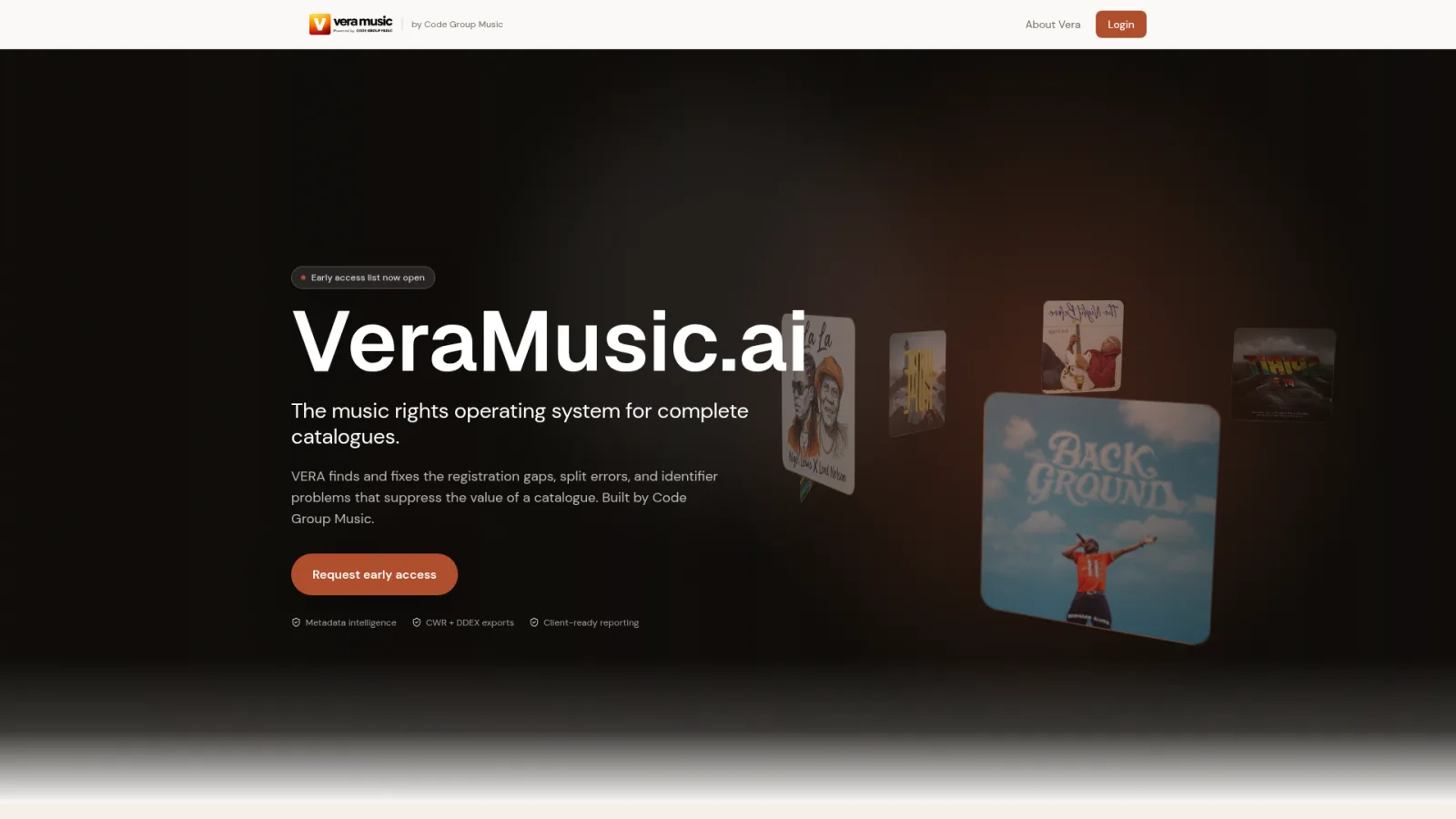
VERA is the music rights operating system we designed and built for Code Group Music. It ingests a catalogue, enriches it against sources like MusicBrainz, Spotify and ASCAP, and scores every track for rights-data completeness.
It puts a pound value on what broken metadata is costing, then generates the CWR 2.2 and DDEX ERN 4.0 files needed to register works and deliver to streaming platforms.
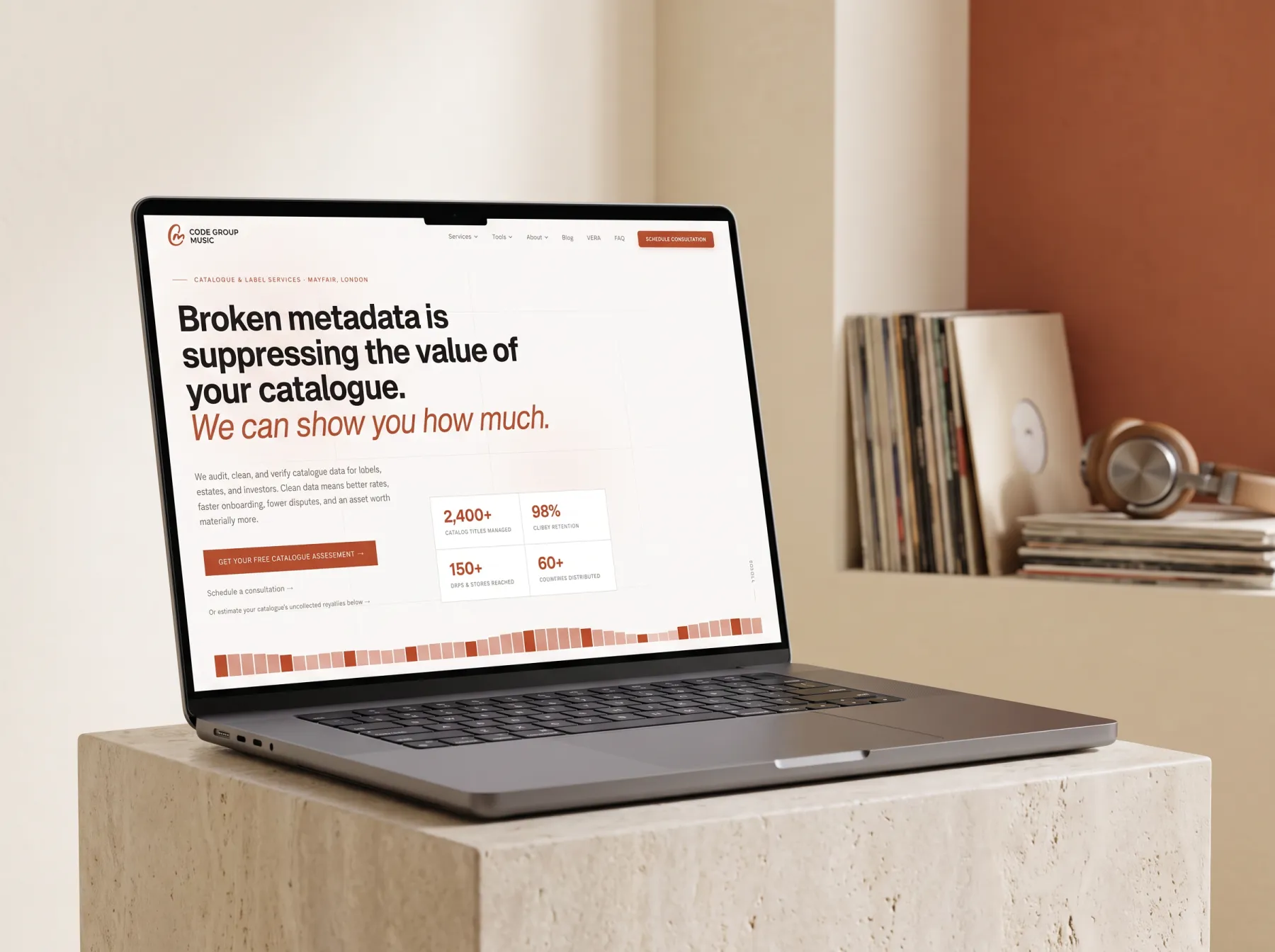
We also designed and built the public early-access website that explains it.
~12 wks
from first commit to full platform
255k+
SESAC writers indexed for instant lookup
600+
automated tests passing at handover
VERA launched as Code Group Music's proprietary platform in 2026. The numbers above describe the verified scale of the build; client outcome metrics will be published as the platform's early-access programme matures.
(Challenge)
Bad metadata quietly drains money out of music catalogues. A missing ISRC, an orphaned writer split or an unregistered work means royalties earned but never collected. Code Group Music had spent years fixing this by hand and wanted that expertise turned into a product.
The hard part was depth. Rights administration is full of detail that matters: ISRC versus ISWC, C-lines versus P-lines, IPI numbers, per-society registration states, territory rules. The platform had to treat those as first-class concepts, not tooltips.
It also had to be trusted by professionals: every AI suggestion reviewable, every change auditable, every export built to the real industry specs. And the website had to prove a new product before there were client results, for two buyers at once: catalogue owners who want an audit, and rights teams who want to run the platform themselves.
(Solution)
We built VERA as a complete workspace: a spreadsheet-grade catalogue editor across 150+ metadata fields per track, a 14-step guided ingest wizard, bulk import with per-row validation, and release management that syncs with MusicBrainz and Spotify.
At its core sits the VERA Verification Score, an original scoring engine that grades every track across eight rights-data modules, adapts its weighting to heritage or active-release catalogues, and gates checks by territory. Each gap lands in a prioritised register with a fix and an indicative royalty uplift in pounds.
AI does the heavy lifting with a human gate on everything. Claude-powered enrichment proposes metadata from fifteen sources into a review queue, and nothing writes directly to the catalogue. A streaming chat assistant, semantic search and audio fingerprinting round out the intelligence layer.
The platform ships with a read-only client portal, an admin control tower with client masquerade, a visual automation builder, and spec-accurate CWR 2.2 and DDEX ERN 4.0 file generation.
The website makes all of this readable in one scroll. It frames the category as "the music rights operating system for complete catalogues", shows the service as five stages (ingest, validate, flag, remediate, verify), uses a clearly labelled illustrative report instead of invented outcomes, and gives each buyer their own form and next step.
(Highlights)
An original scoring engine
The VERA Verification Score grades rights-data completeness across eight weighted modules, with swappable weight profiles and territory-aware checks, mirrored in SQL and TypeScript.
Industry-standard file formats
CWR 2.2 and DDEX ERN 4.0 serialisers written from the specifications, producing submission-ready files for PRO registrations and DSP delivery.
AI with a human in the loop
Every AI and enrichment proposal goes through a review queue with approve, reject and safe bulk-approve, plus a full audit trail and per-field provenance.
Security engineered in
Invitation-only access enforced at the database layer, row-level security throughout, MFA, SSO via WorkOS, and no API keys ever shipped to the browser.
Agent-ready by design
A dedicated MCP server exposes VERA's catalogue and task tools to AI assistants like Claude, with per-tool permissions controlled from the admin settings.
Two buyers, two routes
The website splits its next step: an audit conversation for catalogue owners and an early-access request for platform teams.
Want something like this?